
.png)
Convenience: Amazing or Annoying?
- Ethan Egan

- Aug 30
- 5 min read
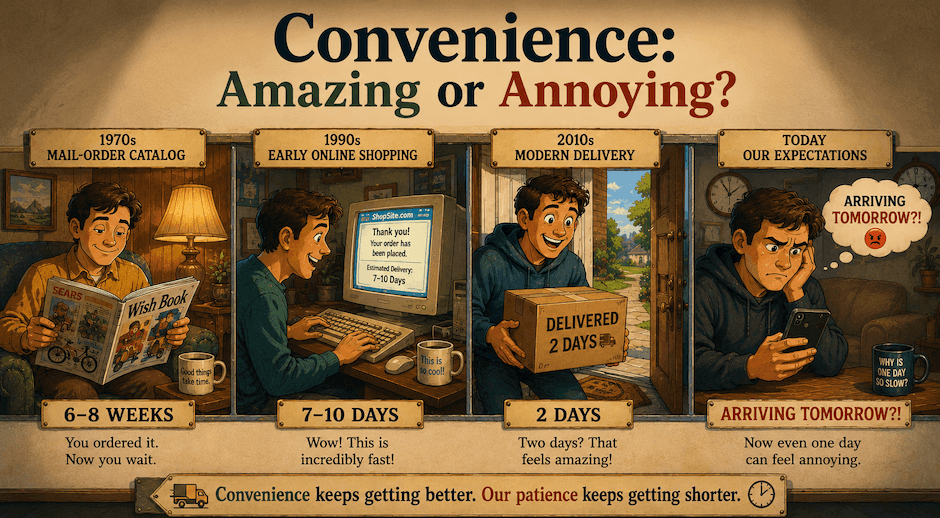
Convenience is supposed to make life easier. We invent something that saves time, reduces effort, or eliminates an inconvenience, and for a while it feels remarkable. Then something interesting happens. We get used to it. Eventually, what once felt remarkably convenient stops feeling convenient at all. It simply becomes normal. Once it becomes normal, anything slower, harder, or less efficient can begin to feel unacceptable.
I wonder if convenience changes our expectations faster than it changes our happiness.
When Fast Becomes Slow
Consider something as ordinary as waiting for a package. There was a time when people ordered merchandise from catalogs by filling out an order form, mailing it with payment, and waiting weeks for the purchase to arrive. There was usually no tracking number providing constant updates. You placed the order and waited.
Then shipping became faster. A couple of weeks became one week. A week became several days. Two-day shipping became common. Next-day and even same-day delivery became possible. Now imagine ordering something and learning that it will arrive in four days. Four days would once have seemed remarkably fast. Today, depending on what we have become accustomed to, four days might feel slow. The delivery didn’t get objectively worse. Our expectation changed.
The same thing has happened with information. There was a time when having a question did not necessarily mean having an answer. You might ask someone who knew more about the subject, look through an encyclopedia, visit a library, or simply remain curious until you eventually encountered the information. Today, we can ask a question and receive an answer within seconds. That is an extraordinary improvement in access to information. Yet when a webpage takes several seconds to load, those few seconds can feel irritating.
We gained almost instantaneous access to enormous amounts of human knowledge, and somehow we also developed the ability to become annoyed because it took six seconds. Human beings are interesting creatures.
Yesterday’s Luxury Becomes Today’s Minimum
Television provides another example. For decades, television programs aired at particular times. If you missed an episode, you might have to wait for a rerun. Eventually we got VCRs and DVRs. Then came on-demand programming and streaming services. Now entire seasons of some programs are available at once.
Each development gave viewers more control over when and how they watched television. But our expectations changed along with the technology. Waiting a week for another episode, once an entirely ordinary part of watching television, can now feel inconvenient.
Air conditioning may be an even better example because the change is so easy to feel. For most of human history, people lived without modern air conditioning. In hot climates, they adapted their homes, clothing, schedules, and behavior to the heat. Modern air conditioning dramatically changed everyday comfort.
But once someone becomes accustomed to living in an air-conditioned home, they probably don’t walk into a room at eighty degrees and think about how extraordinarily comfortable it is compared with living in Florida a century ago. They think, “Why is it so hot in here?” The improvement is still there. We simply stopped experiencing it as an improvement because it became our baseline.
Convenience Teaches Us What to Expect
That may be one of the most interesting things about convenience. It doesn’t merely give us something better. It teaches us what we should expect the next time.
If a website loads instantly fifty times, the fifty-first time it takes ten seconds can make us wonder what is wrong with it. If messages can be delivered instantly, a delayed response becomes noticeable. If we can track a package through every stage of delivery, suddenly not knowing exactly where something is can feel uncomfortable.
That last example becomes especially funny when you consider how recently we had almost no information about a package after ordering it. Now we can become concerned because the tracking page hasn’t updated since 2:17 p.m. Nothing necessarily happened to the package. The little digital dot stopped moving. Now we have questions.
This doesn’t necessarily mean people have become spoiled or ungrateful. I think that explanation is too easy. Human beings adapt. When something becomes part of ordinary life, our expectations adjust to include it. Psychologists use the term “hedonic adaptation” to describe the tendency for people to become accustomed to changes in their circumstances. Positive changes can make us happier, particularly when they first occur, but over time some of that emotional effect can diminish as the new situation becomes familiar. Convenience seems to have its own version of that process.
What Happens When Friction Disappears?
Most conveniences remove some form of friction from everyday life, and that is generally a good thing. We didn’t invent washing machines because washing clothing by hand was an important experience that humanity desperately needed to preserve. We didn’t develop online banking because standing in line at the bank built character. We don’t need to make ordinary tasks unnecessarily difficult simply to prove that we can tolerate inconvenience.
But there may be an unintended consequence when more and more friction disappears. The friction that remains becomes easier to notice. When most things happen quickly, waiting feels slower. When information is usually available immediately, uncertainty becomes more noticeable. When entertainment is constantly available, having nothing interesting to do can feel unusual. When communication is nearly instantaneous, delayed communication can start to seem meaningful even when it isn’t.
Technology doesn’t only change what we can do. It can change what feels normal.
The First Time We Notice That It Works
There is a strange reversal that happens as convenience becomes familiar. The first time we experience a new convenience, we notice that it works. After we have experienced it hundreds of times, we notice when it doesn’t.
Nobody celebrates every successful internet search. We don’t marvel each morning that hot water came out of the faucet. We don’t applaud the refrigerator for keeping the milk cold overnight. We don’t stare appreciatively at the microwave because it heated dinner in three minutes. Those things have become ordinary. Their absence, however, would become noticeable immediately.
Perhaps that helps explain why improvements in everyday life don’t always feel as significant from inside the period in which they occur. Once an improvement becomes ordinary, we stop comparing our experience with life before the improvement existed. We compare it with what we have come to expect now.
Progress Can Move the Starting Line
None of this is an argument against convenience. I am quite fond of refrigeration, air conditioning, fast information, modern transportation, and not spending an afternoon hand-washing laundry. Convenience improves lives.
But convenience also has a quiet second effect. Every improvement has the potential to move our starting point for what we consider normal. Once the starting point moves, the improvement itself becomes harder to see. Yesterday’s extraordinary becomes today’s ordinary. Today’s ordinary becomes tomorrow’s expectation.
And tomorrow, when something takes a little longer than expected, we may find ourselves irritated by a level of convenience that would have amazed us not very long ago. Maybe that is one reason progress can be difficult to appreciate while we are living through it. The better something becomes, the faster we learn to stop being impressed that it works at all.
Until it doesn’t.


Comments